
Quantum Dots – Why do they matter?
Quantum dots provide ultra-vivid hues and better quality pictures for screens using fabrication and technology that is currently within reach and financially accessible. Look for the next generation of televisions to use this technology, as well as computer and mobile screens (with enhanced power/battery savings), photovoltaics, diode lasers, medical imaging and quantum computing.
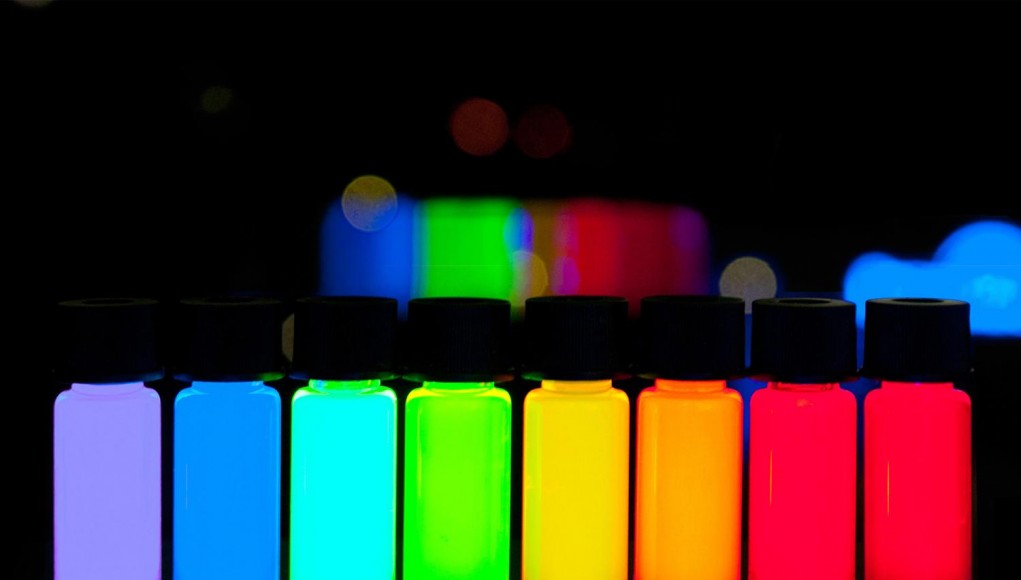
What are they?
They’re really tiny particles – typically with a radius of 5-10nm. Need more? The detailed answer is: quantum dots are semiconductor heterostructures with quantum confinement to zero dimensions.
What does that mean?
Quantum confinement is when excitons (electron-hole quasiparticles) are squeezed in a semiconductor nanocrystal that is smaller than the wavelength of the electron (in other words, smaller than the Bohr radius). Nanoscale physical confinement like this causes the electron to transition from a continuous to a discrete energy state. The discrete energy state is affected by the confined space of the tiny semiconductor nanocrystal and causes predictable excitation wavelengths. The wavelength can be precisely selected based on the size of the semiconductor nanocrystal, or rather, the size that you squeeze the excitons down to.
How do they work?
Quantum dots absorb light and re-emit it at a different wavelength than it was first absorbed at – a longer wavelength. Generally, they absorb blue or UV light and emit it in the visible range of the spectrum – most commonly, as red or green light. In TVs and screens, you’ll generally see them used with blue LEDs to achieve a full range of bright, low-loss/low-filtered light, unlike older generation LCD televisions, which used filters to achieve white LED light and a range of colors.
The size of nanocrystal used during the fabrication of quantum dots changes the width of the semiconductor bandgap due to the quantum-size effect and allows for very precise adjustment of the desired emission wavelength. Essentially, you choose the color you want by squeezing the excitons to the corresponding size.
Since you can fabricate quantum dots to very precise emission wavelengths and the spectral width of the light emitted can be very narrow, you can get very pure colors, and much more vivid colors than colored LEDs.
In practical application, quantum dots have been used as backlights to improve the color gamut and brightness of LED TVs, while keeping the prices cheaper than OLED TVs, although with their reliance on LEDs, they cannot produce blacks as well as the OLED televisions.
Materials
Quantum dots are typically made of Cadmium selenide (CdSe) and Cadmium telluride (CdTe), which are limited for use below 100 ppm due to toxicity by EU regulations. Since the amount of cadmium used in quantum dot televisions is extremely low and noticeable effects on health have not been observed, some manufacturers simply use cadmium amounts just below the 100 ppm limit, while others use Indium (In). Indium is not currently banned for use, but doesn’t provide quite as high-quality colour, and may be banned in the future for the same reason as cadmium.