
Open innovation in Photonics well expresses the need of cross-sectional technologies and a huge opportunity to speed up innovation processes and external collaboration. But specially for SMEs and start-ups there’s a lot to do to deal with ever-shorter cycles of innovation. Today we must improve our innovation processes and guidelines and practical information help to cover this necessity.
Open innovation strategies are designed to accelerate innovation getting the most of entrepreneurship environments and strategic partners. It supposes permitting the use of ideas, processes and channels outside of the company and the other way around: bringing in ideas, processes, inventions and channels born in external organizations. A guidelines of integration of open innovation approaches aims to support SMEs and start-ups to take advantage of the potential services and overcome the so called “Valley of death” (the negative cash flow in early stages of commercialization).
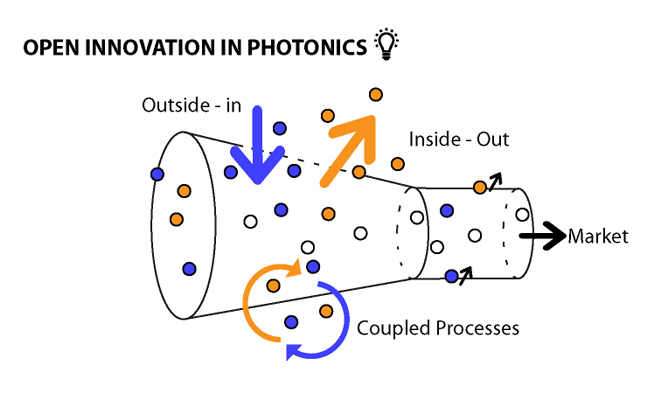
The European Union and Photonics for all wants to help to embrace open innovation sharing this guidelines. These are its 10 key points:
I. There’s an urgent need to integrate innovation methodologies specially in SMEs, microcompanies and start-ups
A survey across companies and institutions of the field of photonics, mainly in Germany, proved that well-established innovation management exist in more than 50% of them BUT in more than the half of the cases innovations could be implemented more efficiently and based in solider structures.
II. Traditional idea generation models are still very common
Nonetheless a lot of the participants are involved in innovation networks, platforms and have had contact with crowd-sourcing, agencies, users and markets. Cooperation with competitors in a pre-competitive stage is on the contrary highly unusual and deterrent. Licensing, external idea realization, spin-offs and the basic outlines of innovation are known but there’s an important lack of methodology and efficiency. This is an important detected need.
III. Let’s better not re-invent the wheel
Open innovation offers the chance of complementary interactions and win to win businesses taking advantage of the R&D and knowledge fertility in companies and invention networks. Instead of spending a lot of resources in long term internal developments might be players out there offering that same knowledge or technology with whom is worth to partner with.
if the smart people within your company are aware of, connected to, and informed by the efforts of smart people outside then your innovation processes will reinvent fewer wheels. What’s more, your internal efforts will be multiplied many times through their embrace of others’ ideas and inspiration”. Henry Chesbrough
the motivation for embracing open innovation comes from the possibility of a rapid integration of new technologies that help to cover internal missing competencies. For example, What could be more interesting than rapidly covering the company’s lack of capabilities establishing an “outside -in” perspective?
IV. Let’s take it to practice
The implementation of open innovation processes is already in the agenda, BUT what is new is not its existence but the next level: “how to boost it up”. It is to say, the systematic integration of open innovation in the innovation process. The goal is therefore the rapid integration of new technologies. How can the SMEs work towards this direction? how to take into the practice the outside-in and inside-out processes in their daily lives?
V. Most important reasons why
For SMEs and start-ups the advantages of embracing open innovation are not few. The most important reasons for taking this road are:
- Create competitive advantages
- Satisfy customers’ needs
- Growth based on innovation and higher market impact
- Widen strategic partnerships
- More sales and bigger market share
- New products and services based on market needs and therefore higher market acceptance
VI. A new open innovation culture
A preliminary conclusion may be said here: companies need a new open innovation culture as a whole. A new management paradigm implies a shift from this idea “what we discover first, we bring first on the market“, to this another “We don’t need to have invented something to benefit from it“.
It is important to highlight that is the people the key motor of innovation upon the processes. Consequently, only in an opened corporate climate this shift can be understood and allowed nonetheless opposition and different points of view. We are talking not about an aspect of the organization but about the dominant culture of the company.
VII. How much do we use open innovation tools?
To optimize open innovation methodologies a good tool box is needed, BUT the main goals have to be clear for everyone in the organization and the corporate environment should promote innovation.
The most important general tools for open innovation are:
- SWOT analysis
- Formulation of goals
- Functional analysis
- Market analysis
- Benckmarking
- State gate
- Design thinking
- InnoSME
VIII. Outside-in and inside-out: two complementary directions
Outside-in and inside-out open innovation perspective are complementary. The first is inspired on the identification and integration of external ideas through different strategies such as licensing, idea portals, virtual knowledge broke or shareholding. The second one is inspired on the other direction, the external use of own ideas. Examples are licensing, spin-offs, and participation in competitions.
IX. Internet based activities
Internet is one of the natural channels of exposing ideas and networking. Crowdsourcing, crowdsolving and crowdfunding talk about the ecosystem of collaborative aims towards collective actions. For example crowdsourcing is a road to build a community of multidisciplinary and multi-sectoral collaborators looking to achieve a specific goal.
Crowdfunding has shown to be as well one of the most interesting ways to finance early stages of innovation. And everything on Internet has often multiple contact points with social media.
X. Interdisciplinary cooperation and transfer processes
Photonics is one of the fields that uses the best of cross-sectional technologies and multidisciplinary sources. But every open innovation project (even in service innovation) is very close to theses qualities. For example, technology transfer between R&D centres and companies need to be supported to close the gap between investigation and innovation and bridging new sources of open innovation are created. For a lot of start-ups and SMEs networking and the use of platforms are more than needed to keep the track of opportunities, to take external inventions and knowledge into the company but also to show to the market the services, products and knowledge they have.